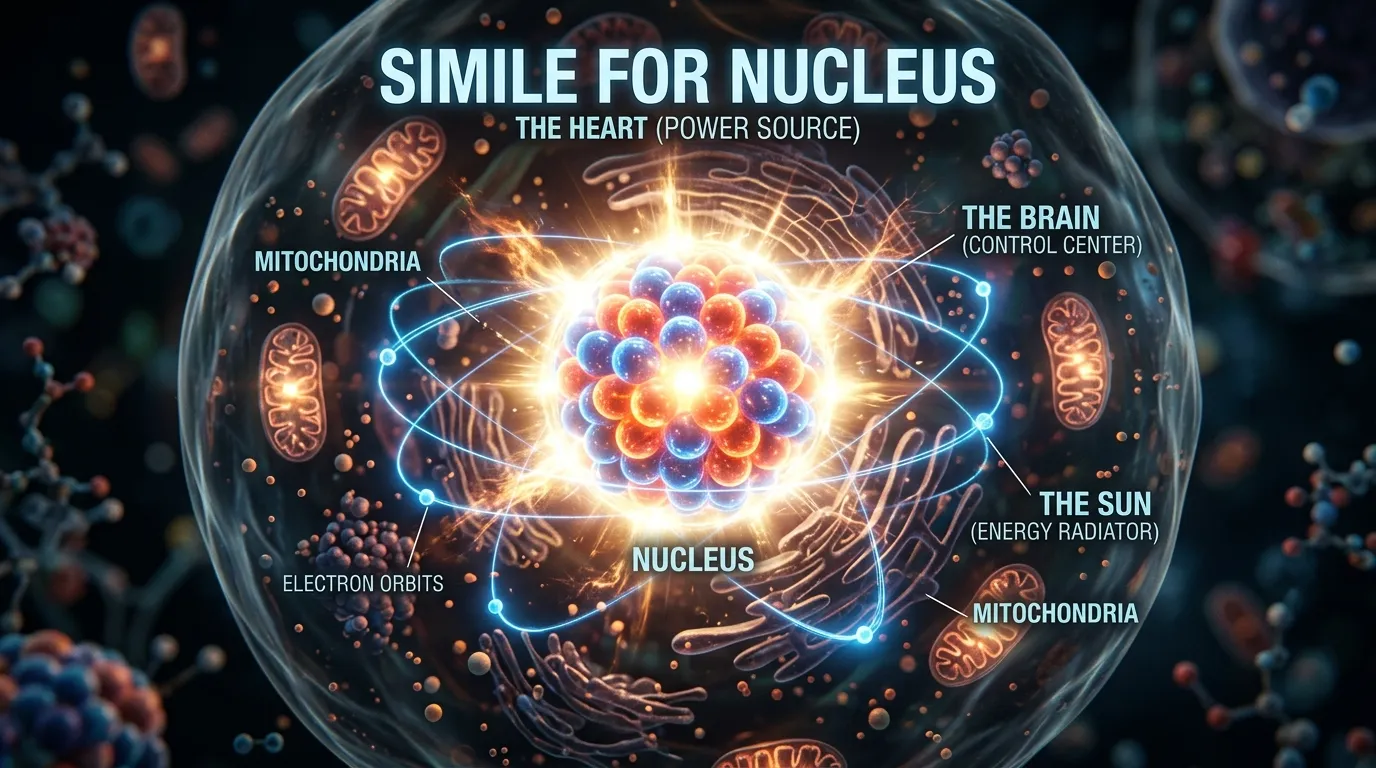
I remember the moment clearly I was trying to explain the concept of a nucleus, and honestly, I felt stuck. I knew the definition, but it just wasn’t clicking in a way that felt simple or relatable.
Then I thought, why not compare it to something familiar? That’s when I started using similes, and everything changed. I told myself, “I need a simile for nucleus that actually makes sense.
” So I imagined it like the heart of a city everything important happening around it, controlling the whole system. Suddenly, it became easier, not just for me, but for anyone I explained it to.
Now I’m sharing this with you because I’ve been exactly where you are confused but curious. And trust me, once you start using a strong simile for nucleus, the concept stops feeling complicated and starts feeling obvious.
Let,s dive in!
What Is a Simile? (Simple Explanation)
A simile compares two different things using like or as.
👉 Example:
The nucleus is like the brain of the cell.
Here, the nucleus is compared to a brain because both control important actions.
Why Similes Matter in Writing:
- They make ideas easier to understand.
- They improve creative writing.
- They help readers visualize concepts.
- They make learning fun and memorable.
In creative writing similes, you don’t just explain you show.
15 Similes for Nucleus (With Meaning & Examples)
1. The nucleus is like the brain of a cell.
Meaning: It controls activities.
Explanation: Just as the brain guides the body, the nucleus directs the cell.
Examples:
- The nucleus works like the brain, sending instructions everywhere.
- Without the nucleus, the cell would act like a body without a brain.
2. The nucleus is like a command center.
Meaning: Central authority.
Explanation: Everything depends on it for direction.
Examples:
- The nucleus acts like a command center managing operations.
- Inside the cell, the nucleus functions like a busy control room.
3. The nucleus is like the heart of a city.
Meaning: Central importance.
Explanation: It keeps everything alive and organized.
Examples:
- The nucleus sits like the heart of a city, full of activity.
- Energy flows through the cell from the nucleus like life from downtown.
4. The nucleus is like a king ruling a kingdom.
Meaning: Leadership and control.
Explanation: It governs all cellular processes.
Examples:
- The nucleus ruled the cell like a wise king.
- Messages spread from the nucleus like royal commands.
5. The nucleus is like a library of instructions.
Meaning: Stores information.
Explanation: DNA inside the nucleus holds genetic knowledge.
Examples:
- The nucleus works like a library storing life’s secrets.
- Scientists study the nucleus as if reading a grand archive.
6. The nucleus is like the sun in a solar system.
Meaning: Central position and influence.
Explanation: Everything revolves around it.
Examples:
- Organelles move around the nucleus like planets around the sun.
- The nucleus shines as the center of cellular activity.
7. The nucleus is like a manager in an office.
Meaning: Organization and supervision.
Explanation: It coordinates tasks.
Examples:
- The nucleus managed cell work like an office manager.
- Every process waited for orders from the nucleus.
8. The nucleus is like a computer processor.
Meaning: Information processing.
Explanation: It controls functions using stored data.
Examples:
- The nucleus processed signals like a powerful CPU.
- Instructions flowed from the nucleus like digital commands.
9. The nucleus is like a blueprint vault.
Meaning: Holds designs.
Explanation: DNA provides plans for growth.
Examples:
- The nucleus protected DNA like a vault guards blueprints.
- Growth followed instructions stored inside the nucleus.
10. The nucleus is like a teacher guiding students.
Meaning: Direction and learning.
Explanation: It guides cell activities.
Examples:
- The nucleus guided the cell like a patient teacher.
- Organelles learned their roles from the nucleus.
11. The nucleus is like the captain of a ship.
Meaning: Leadership and navigation.
Explanation: It directs movement and survival.
Examples:
- The nucleus steered the cell like a skilled captain.
- Without the nucleus, the cell drifted like a lost ship.
12. The nucleus is like a power headquarters.
Meaning: Central control hub.
Explanation: Decisions originate there.
Examples:
- The nucleus served as headquarters for the cell.
- Signals moved outward from the nucleus like official orders.
13. The nucleus is like a seed in a fruit.
Meaning: Source of life.
Explanation: It contains genetic beginnings.
Examples:
- Life began in the nucleus like growth from a seed.
- The nucleus held potential like a tiny seed.
14. The nucleus is like the main switch of a building.
Meaning: Controls operations.
Explanation: Turning it off stops function.
Examples:
- The nucleus acted like the main switch controlling activity.
- When damaged, the cell shut down like lights without power.
15. The nucleus is like a storyteller holding history.
Meaning: Contains identity information.
Explanation: DNA tells the story of life.
Examples:
- The nucleus preserved identity like a storyteller.
- Each cell carried its story inside the nucleus.
Practical Exercise: Practice Similes (10 Questions)
Questions:
- Complete the simile: The nucleus is like the ______ of the cell.
- Which simile shows leadership?
a) Seed
b) King
c) Cloud - Identify the simile: “The nucleus works like a manager.”
- Fill in: The nucleus stores DNA like a ______.
- True or False: Similes use like or as.
- Which simile shows storage of information?
- Complete: The nucleus shines like the ______ of a solar system.
- Which sentence contains a simile?
a) The nucleus controls the cell.
b) The nucleus is like a brain. - Write one simile comparing nucleus to a leader.
- Why do writers use similes?
Answers with Explanations:
- Brain — shows control.
- b) King — represents authority.
- Uses like, so it is a simile.
- Library / Vault — shows storage.
- True — similes need comparison words.
- Library of instructions — emphasizes information.
- Sun — central importance.
- b) — contains comparison using like.
- Example: The nucleus is like a captain guiding a ship.
- Writers use similes to make ideas clearer and more creative.
Conclusion:
Similes are powerful tools in writing. They help readers understand complex ideas even scientific ones like the nucleus through simple comparisons. By using creative writing similes, you turn learning into storytelling.
Now that you know the meaning of similes and have explored many simile sentences, try creating your own. Think about what the nucleus represents: control, memory, leadership, or life itself. Then compare it to something familiar.
The more you practice how to use similes in writing, the more vivid and engaging your words will become. So grab a notebook and start building your own examples of similes today!